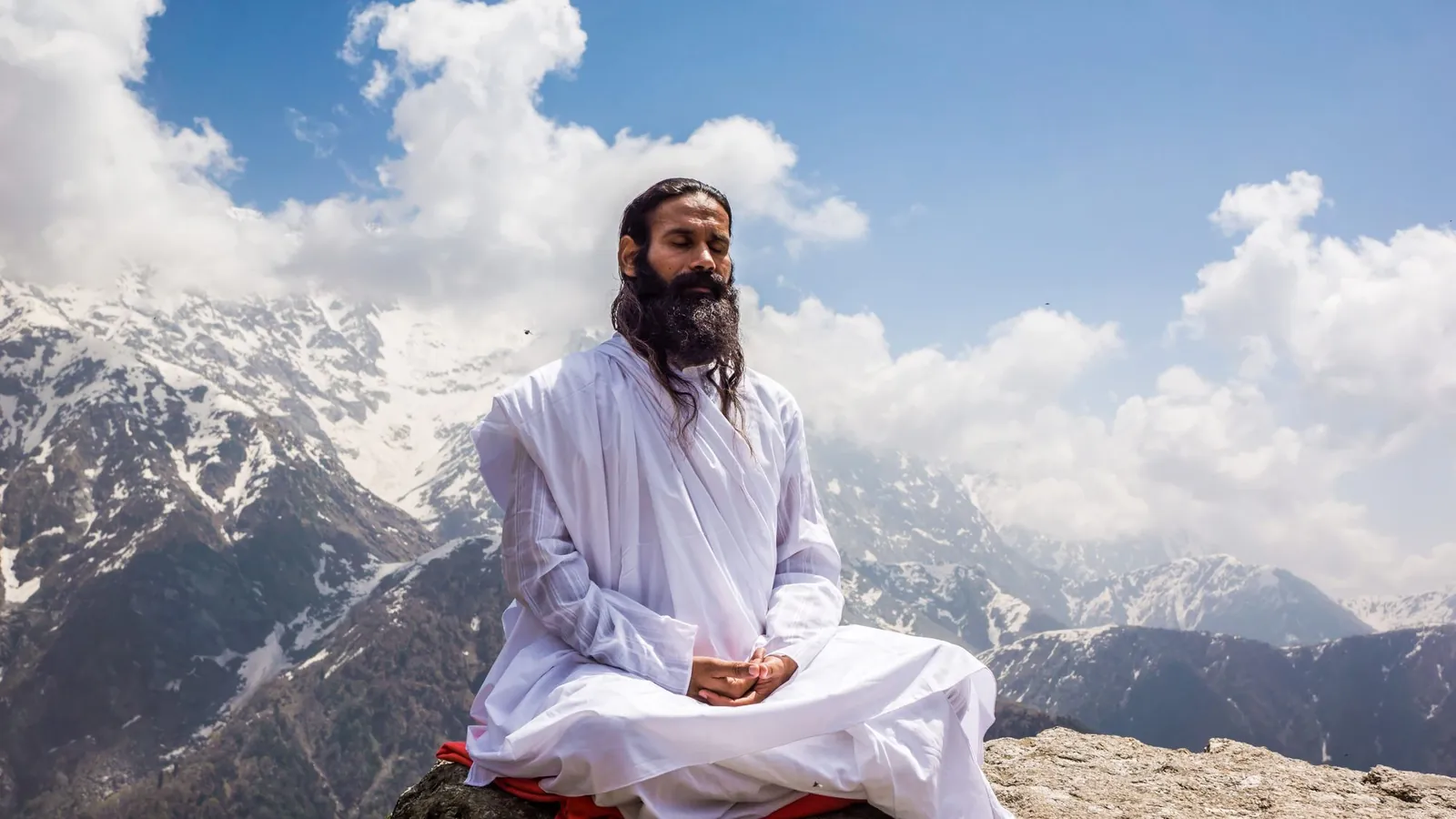

Most human beings spend their entire lives looking outward for answers, happiness, security, and truth.
We look to external circumstances, relationships, material achievements, and social validation to define who we are and how we feel. Yet, as Senior Pyramid Master Anil illuminates in his profound discourse on the inward journey (Antarmukha Prayanam), this external orientation is the fundamental misconception that keeps us trapped in cycles of suffering, confusion, and reactive living.
The ultimate truth (Satyam) is not located in the physical world outside of us. The external world is merely a mirror, a projection of our internal state of consciousness. Whether we realize it or not, we are secretly creating our own reality every single moment through our thoughts, subconscious frequency, and degree of inner alignment. By shifting from an outward-focused existence (Bahirmukha) to an inward journey (Antarmukha Prayanam), we uncover the timeless mechanics of consciousness that allow us to step out of illusion and awaken as the conscious creators of our lives.
1. The two realms of truth: Paramarthika Satyam vs. Vyavaharika Satyam
To understand how reality is created, we must first examine the nature of truth itself. Classical Vedantic philosophy and spiritual wisdom distinguish between two distinct dimensions of reality:
- Paramarthika satyam (absolute truth): The underlying, unchangeable, eternal reality (Nitya). It is pure, unconditioned consciousness that remains constant across time, space, and form. It is undivided, birthless, and deathless.
- Vyavaharika satyam (relative or empirical truth): The transactional, phenomenal world (Anitya). It includes physical objects, daily activities, bodily sensations, thoughts, and emotions. While experienced as real in daily life, it is fundamentally impermanent, dynamic, and constantly changing.
| Dimension | Sanskrit term | Nature | Key characteristic | Spiritual status |
|---|---|---|---|---|
| Absolute reality | Paramarthika Satyam | Unchanging, Eternal (Nitya) | Pure Witness Consciousness (Sakshi) | Ultimate Truth |
| Relative reality | Vyavaharika Satyam | Changing, Fleeting (Anitya) | Physical & Mental Phenomena (Maya) | Transactional Instrument |
The core mistake of human existence occurs when we mistake Vyavaharika Satyam (the temporary, relative world) for Paramarthika Satyam (the permanent, absolute truth). We attach our identity to changing roles, financial standings, body conditions, and emotional states, treating them as if they are permanent. When these temporary phenomena inevitably change or deteriorate, we experience deep psychological suffering.
Master Anil points out that true spiritual maturity does not require abandoning relative reality or neglecting family, career, and daily responsibilities. Rather, it requires changing our relationship to it. When we realize that the physical world is a relative playground governed by the absolute space of consciousness within us, we interact with the world gracefully without becoming bound by it.
2. The hidden law of reflection: Yatha Antaram, Tatha Bahiram
A central pillar of inward wisdom is the cosmic law: As within, so without (Yatha Antaram, Tatha Bahiram). The outer world does not dictate your inner state; your inner state magnetizes and shapes your outer world.
Every thought, feeling, and subconscious belief generates a specific energetic frequency. According to the Law of Attraction (Akarshana Sutram), the universe responds not to what you superficially claim you want, but to the exact vibration you embody. If your mind is consumed by fear, scarcity, anger, or comparison, the outer world naturally reflects back situations that reinforce those precise frequencies. Conversely, when meditation quietens the mental chatter and settles the heart in peace, harmony, and gratitude, the external environment rearranges itself to match that inner stillness.
| INNER consciousnesssubconscious impressions (vasanas), frequency, & witness state |
|---|
| ▼ |
| ENERGETIC fieldvibrational emission (heart-brain coherence / aura) |
| ▼ |
| OUTER EXPERIENTIAL realitycircumstances, relationships, opportunities, & reflection |
The mechanism of unconscious creation
- Subconscious imprints (vasanas): Past experiences, trauma, and ancestral conditioning store vibrational patterns in the subtle body.
- Automated projection: Without active awareness, these imprints continuously broadcast a signal into the universal field.
- Outer attractivity: The physical environment responds to the dominant broadcast, creating repetitive life patterns, karmic loops, and recurring emotional conflicts.
- Awakening consciousness: By turning inward through meditation (Anapanasati), we observe these imprints without identification, allowing them to dissolve and raising our baseline frequency.
3. Discernment in action: Nitya-Anitya Vastu Viveka and Atma-Anatma Vichara
To break free from secret, destructive reality creation, the seeker must cultivate active spiritual discernment (Viveka). The scriptures highlight two primary analytical tools for self-inquiry:
- Nitya-anitya vastu viveka: The systematic discrimination between that which is eternal (Nitya) and that which is temporary (Anitya).
- Atma-anatma vichara: The deep investigation into what is the true Self (Atma) versus what is the non-Self (Anatma, body, mind, intellect, and ego).
When an uncomfortable emotion, physical pain, or external crisis arises, the untrained mind immediately identifies with it, saying, “I am hurting,” “I am a failure,” or “I am angry.” Spiritual discernment interrupts this automatic identification.
By applying inquiry, the seeker recognizes:
“Pain is occurring in the body, but I am the observer of the body, not the pain itself. Anger is surfacing in the mental realm, but I am the conscious space in which anger appears and disappears. Therefore, this suffering belongs to the non-Self (Anatma), while I remain the untainted witness (Atma).”
This subtle shift in awareness instantly breaks the continuous loop of psychological suffering. Pain remains a physical or emotional sensation, but it is no longer converted into long-term mental anguish.
4. The witness state (Sakshi Bhava): resting in the unchanging core
In the Svetasvatara Upanishad, the divine reality is described as:
“Eko Deva Sarvabhuteshu Gudha, Sarvavyapi Sarvabhutantaratma, Sarvadhyaksha Sarvabhutadhivasi, Sakshi Cheta Kevalo Nirgunascha.”
Svetasvatara Upanishad
This verse declares that one supreme divine consciousness dwells hidden within all beings, pervading all things as the innermost Soul, presiding over all actions, and existing as the pure, unattached Witness (Sakshi), free from all attributes (Nirguna).
Master Anil emphasizes that living in truth (Satyam) means anchoring oneself in this Sakshi Bhava (Witness Consciousness). The mind, by its very nature, fluctuates between likes and dislikes, pleasures and pains, successes and failures. The witness, however, never moves.
| PURE WITNESS (sakshi)unmoving, silent consciousness | ||
|---|---|---|
| ▼ | ▼ | ▼ |
| Physical bodysensations / pain | Mind & ThoughtsFleeting Ideas / Intent | Emotions & MoodsFluctuating Energies |
When you operate as the observed (the ego-mind), your mood changes ten times a day depending on external feedback. When you steady yourself as the observer (the witness), equanimity (Samatvam) becomes your natural state. You see thoughts like clouds passing across an open sky. You do not fight the clouds; you simply remain as the vast, luminous sky.
5. Dissolving karmic conditioning through wisdom (Jnana)
A common question among spiritual aspirants is how past karma (Sanchita and Prarabdha) affects our power to create reality. Can karma be altered or dissolved, or are we bound to suffer its consequences?
Master Anil explains that karma operates strictly on the level of the body, mind, and ego. As long as you identify as the body-mind, you are bound by karmic debt. However, when you awaken to your true identity as pure consciousness, the fire of self-knowledge (Jnana Agni) burns away karmic impressions.
The four paths to karma dissolution
- Repentance & transformation (paschattapam & parivartana): Sincere inner recognition of past mistakes, accompanied by a genuine commitment to align with truth and non-harming (Ahimsa).
- Wisdom & understanding (jnana): Realizing the underlying lesson behind a difficult life situation. Once the soul absorbs the lesson, the karmic pattern has no further purpose and naturally dissolves.
- Cosmic energy influx (meditation & Prana): Sitting in zero-thought meditation (Anapanasati) allows high-frequency cosmic energy to flood the subtle energetic channels (Nadis), clearing dense karmic blockages directly from the aura.
- Selfless service (seva): Engaging in spiritual service without ego or expectation of reward. True Seva purifies the heart and neutralizes negative karmic baggage by dissolving the illusion of personal doership (Kartritva Bhava).
6. Living as the conscious creator: practical integration
Transitioning from an automatic, unconscious reactor to an intentional, conscious creator is a gradual process requiring daily practice and inner discipline.
Daily disciplines for living reality
| Daily discipline | Practice |
|---|---|
| 1. Daily silent meditation | Practice Anapanasati to quiet the mind and stabilize witness consciousness. |
| 2. Self-inquiry (vichara) | Ask “Who am I?” and observe thoughts without taking ownership of them. |
| 3. Conscious alignment | Ensure thoughts, words, and actions are in complete alignment with truth and integrity. |
| 4. Spiritual study (svadhyaya) | Read wisdom literature daily to keep the mind anchored in higher truth. |
| 5. Selfless service (seva) | Share spiritual knowledge and assist others without demanding personal doership or reward. |
Key practices for daily life
- Morning anchoring in meditation: Begin each day with Anapanasati breath meditation. Allow the mind to settle into zero-thought awareness so that your baseline frequency is established in peace rather than survival anxiety.
- Mindful self-observation: Throughout the day, periodically pause and observe your internal state. Notice if tightness, fear, or defensive mechanisms are operating. Gently ask: “What am I identifying with right now? Is this temporary thought who I truly am?”
- Alignment of thought, word, and deed: Living in truth means eliminating the division between what you think, what you say, and what you do. Integrity creates an immensely strong, coherent aura that effortlessly manifests positive outcomes.
- Surrender of doership: Perform your daily duties with full dedication, but surrender the results to the universal consciousness. Recognizing that you are an instrument (Nimitta Matra) through which the divine works frees you from anxiety and attachment.
Final thoughts
You are not a helpless victim of external circumstances, random luck, or oppressive fate. You are, and always have been, the secret creator of your reality. The quality of your life is the direct mathematical projection of your inner frequency and degree of self-realization.
By turning your attention inward (Antarmukha Prayanam), observing the mind as a detached witness, and anchoring yourself in the absolute truth of pure consciousness, the illusions of separation and powerlessness fall away. You step into your birthright, living a life of unshakable peace, spontaneous joy, boundless compassion, and conscious mastery.
0 views