
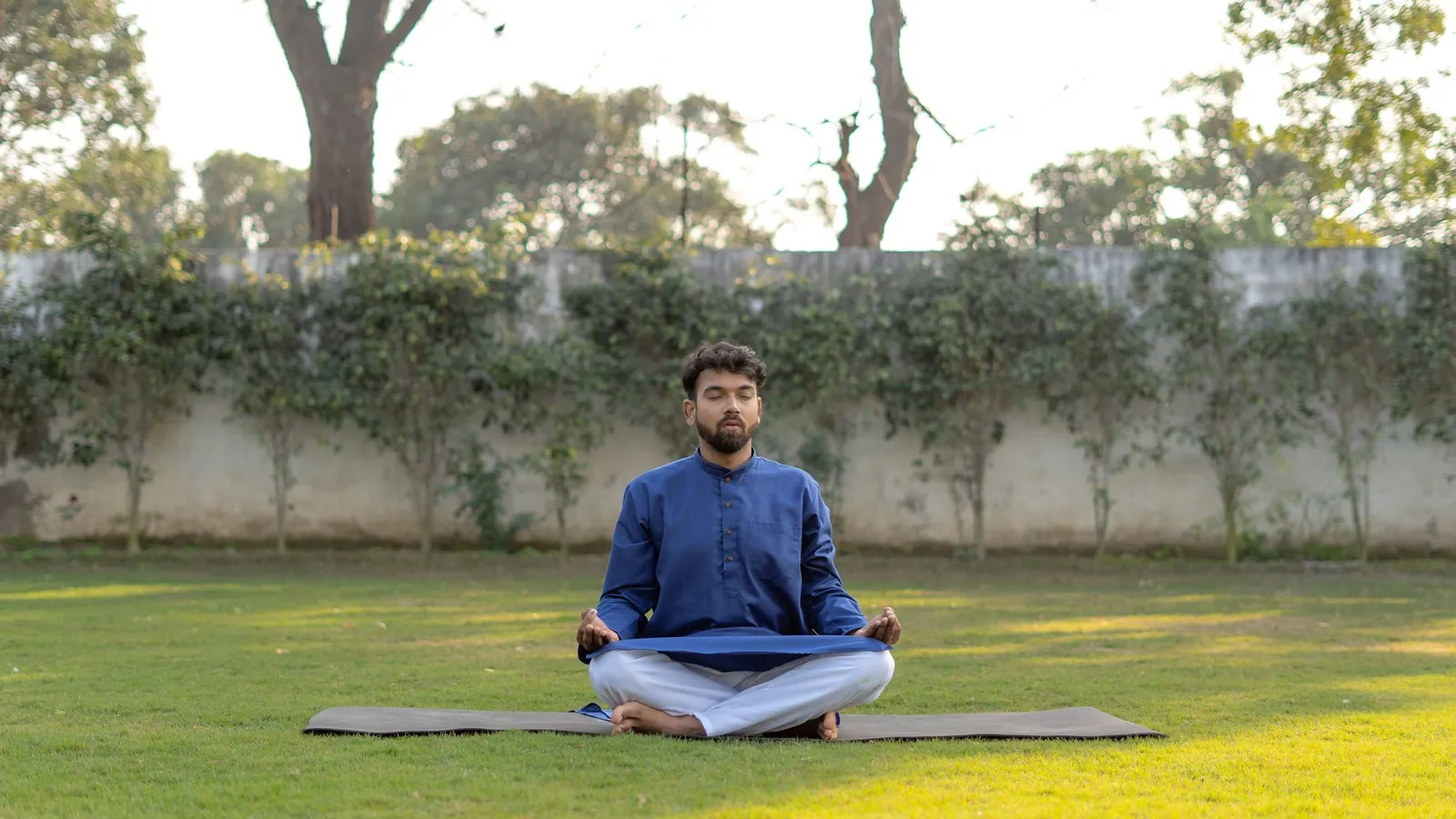
Human life presents an enduring paradox: the very same world, filled with its relationships, challenges, choices, and changes, can feel like an oppressive prison of suffering to one person and a magnificent playground of divine joy to another.
What determines whether our journey through life feels like a heavy burden or a joyful celebration?
According to Brahmarshi Pitamaha Patriji, the founder of the Pyramid Spiritual Societies Movement (PSSM), the answer lies in a single foundational principle: Realization. When the true nature of existence and the soul is understood, life becomes Nirvana (liberation, bliss, and supreme peace). When it remains misunderstood, life becomes Bandham (bondage, entanglement, and suffering).
This profound teaching, Nirvana if known, bondage if not known, serves as a guiding beacon for spiritual seekers. It transforms how we interpret our daily experiences, our personal freedom, and our ultimate destiny.
1. The foundation of soul consciousness & Swa-Ichha (free will)
To understand why realization changes everything, we must first examine how spiritual science views the human soul (Atma). In Brahmarshi Pitamaha Patriji’s discourses, the soul is not a frail, helpless entity subject to external whims. Rather, the soul is an infinite, autonomous spark of Supreme Consciousness (Maha Chaitanyam).
The essential consciousness flow
- Supreme consciousness (Maha chaitanyam): The universal source of all life and awareness.
- The soul (Atma): An autonomous spark possessing intrinsic free will (Swa-Ichha).
- The dual outcomes of awareness:
- If known (wisdom): Leads to Nirvana, witnessing life as divine play (Lila) with inner freedom.
- If not known (ignorance): Leads to Bandham, suffering through attachment, fear, and victimhood.
The principle of Swa-Ichha (self-will)
The fundamental property of the soul is Swa-Ichha, absolute, intrinsic free will. As divine sparks of consciousness, souls possess total freedom of choice. There is no external cosmic judge forcing experiences upon an individual against their deep spiritual will. Every incarnation, role, inclination, and experience is chosen by the soul to explore different facets of existence.
The cosmic law of Tathastu (“so be it”)
Because the universe honors the soul’s intrinsic freedom, it operates under the absolute cosmic principle of Tathastu (a Sanskrit term meaning “So be it” or “Amen”).
Whatever intention or path a soul chooses to pursue, universal consciousness reflects it back with an unwavering Tathastu:
- If a person chooses to dedicate their energy to building temples or serving humanity, the universe affirms: “Tathastu.”
- If a person chooses to explore non-vegetarianism or material indulgence, the universe affirms: “Tathastu.”
- If a person chooses to act as a villain or a tyrant in the human drama, the universe affirms: “Tathastu.”
The universe does not interfere with the soul’s freedom to choose. However, every choice carries its natural law of cause and effect (Karya Karana Sambandham). The cosmic system allows total creative freedom while ensuring that every action yields its corresponding experience for the soul’s learning.
2. Life as cosmic cinema: the Shakespearean stage analogy
To make this profound truth easy to comprehend, Brahmarshi Pitamaha Patriji frequently invokes two relatable analogies: William Shakespeare’s famous theatrical metaphor and the mechanics of modern cinema.
The Shakespearean stage
Shakespeare famously wrote:
“All the world’s a stage, and all the men and women merely players.”
William Shakespeare
In Brahmarshi Pitamaha Patriji’s spiritual framework, this is not merely poetic language; it is a literal description of cosmic reality. The universe is a grand theatrical play (Jagad-Natakam). Before entering this physical world, souls voluntarily step onto the stage of life, wearing body-costumes, taking on script lines, and accepting specific roles, whether as parents, children, leaders, followers, heroes, or antagonists.
The cinema analogy: directors, actors, and characters
Consider how a modern blockbuster movie is created:
- The director & scriptwriter: A director envisions a complex story involving conflict, drama, tragedy, and triumph. The director assigns roles to talented actors.
- The actor’s awareness: An actor playing a villain on screen (such as a ruthless antagonist in an epic film like Baahubali) performs their role with intense dedication during shooting.
- The distinction: The actor knows with absolute clarity that they are not the villain in real life. When the director yells “Cut!”, the actor steps off the set, shakes hands with the hero, eats lunch, and goes home peacefully. The performance was a creative endeavor, not their actual identity.
The relationship between our true spiritual identity and our worldly personality can be understood through the cinematic framework outlined below:
| Dimension of reality | Physical cinema analogy | Spiritual reality |
|---|---|---|
| True identity | The Actor off-camera | Eternal Atma (Soul Consciousness) |
| Role & costume | The Movie Character & Outfit | Physical Body & Mind-Personality |
| Stage & setting | Film Set, Sets & Props | Earthly Circumstances & Environments |
| Script & choices | Screenplay & Dialogue | Soul’s Free Will (Swa-Ichha) & Chosen Karma |
When an actor understands that the film is a temporary artistic expression, they enjoy playing both difficult and enjoyable roles. But what would happen if the actor forgot they were acting?
3. Deconstructing bondage (Bandham): what happens when we don’t know
Bondage (Bandham) is the state of spiritual amnesia. It occurs when consciousness becomes so engrossed in the physical form and earthly script that it forgets its divine source and eternal nature.
The mechanism of ignorance (ajnanam)
When an individual does not possess self-knowledge (Atma-Jnanam), the following psychological and spiritual errors occur:
- Identification with the costume: The individual mistakenly believes, “I am only this physical body, this personality, this social status, and these temporary conditions.”
- Taking the drama as absolute reality: Just as a moviegoer might weep hysterically or panic during a film because they forget it is projected light on a screen, the person lacking self-knowledge takes every conflict, loss, and trial as an absolute tragedy.
- The victim mindset & illusion of injustice: Without understanding cause and effect or soul choice, the individual feels like a helpless victim of circumstance. Brahmarshi Pitamaha Patriji strongly notes that a deep belief in tragedy and unfairness is simply the hallmark of ignorance.
- Fear of death and loss: Because the body is mortal, identifying strictly with the body creates a constant, background anxiety regarding aging, illness, loss, and death.
Real-world example of bondage
Imagine a person experiencing a severe business loss or a broken personal relationship. Under the lens of Bondage (Bandham), they feel ruined, betrayed, and hopeless. They ask, “Why is God punishing me? Why is life so unjust?” They suffer intensely because they see the event as an irreversible catastrophe defining their worth and existence.
4. Experiencing Nirvana: what happens when we know
Nirvana is not a distant, post-death realm located in the sky. It is a state of present-moment liberation, clarity, and unshakeable inner peace available right here on Earth.
The mechanics of wisdom (Atma-Jnanam)
When an individual awakens to their identity as the soul, their relationship with life undergoes a complete transformation:
- Witness consciousness (sakshi bhava): The individual steps back from the emotional chaos of the mind and observes life events as a calm witness, much like a person sitting comfortably in a cinema hall watching an engaging movie unfold on screen.
- Recognizing the divine play (lila): Life’s challenges are no longer viewed as punishments, but as chosen script points designed for soul learning, strength, and experience.
- Freedom from fear: Realizing that the soul is indestructible (Nainam Chhindanti Shastrani) eliminates the root cause of human fear, the fear of non-existence.
- Acceptance of infinite paths: Recognizing that every soul possesses Swa-Ichha allows one to cease judging others. One understands that everyone is acting out their self-chosen evolutionary script.
Real-world example of Nirvana
Consider the same scenario of a business loss or personal trial. Under the lens of Nirvana (Wisdom), the individual remains centered. They recognize: “This body and these finances are temporary props on the stage of life. This trial is testing my resilience, teaching me wisdom, and redirecting my path. I am the eternal soul, untouched by monetary numbers.” They act decisively to resolve the issue while remaining internally peaceful and serene.
5. Comparative breakdown: ignorance vs. wisdom
To see the stark contrast between these two perspectives in daily life, the table below highlights how identical life experiences are processed under Bandham (Ignorance) versus Nirvana (Wisdom):
| Aspect / dimension | The perspective of bondage (Bandham) | The perspective of Nirvana (Nirvana) |
|---|---|---|
| Core identity | Identifies with physical body, mind, name, and social role. | Identifies with eternal, infinite Soul Consciousness (Atma). |
| View of life events | Sees events as random, chaotic, or unfair punishments. | Sees events as purposeful cosmic play (Lila) and self-chosen scripts. |
| Reaction to challenges | Anxiety, panic, anger, despair, and victimhood. | Calm observation (Sakshi Bhava), wisdom, and decisive action. |
| Understanding of free will | Feels trapped, powerless, and controlled by fate. | Recognizes Swa-Ichha (intrinsic free will) and cosmic Tathastu. |
| Attitude towards others | Judgmental, reactive, blaming, and conflict-prone. | Compassionate, understanding, and respectful of others’ soul journeys. |
| Experience of death | Terrifying end of existence and ultimate loss. | Natural transition of changing physical body-costumes. |
| State of mind | Perpetual turmoil, attachment, and existential fear. | Unshakeable peace, inner bliss, and spiritual freedom. |
6. The portal of realization: practicing pure meditation (Anapanasati)
How do we bridge the gap between knowing this philosophy intellectually and experiencing Nirvana practically in our daily lives?
Brahmarshi Pitamaha Patriji emphasizes that intellectual study alone is insufficient. To shift from body-consciousness to soul-consciousness, one must practice Anapanasati Meditation, the simple, natural practice of breath-mindfulness.
Why meditation awakens soul awareness
- Quieting mind-noise: Daily life continuously bombards us with sensory inputs that reinforce body-identity. Sitting quietly and observing the natural breath stills the noisy mind.
- Accessing higher energy (Prana): As the mind becomes quiet, cosmic energy flows abundantly into the physical and subtle bodies, clearing spiritual blockages and expanding awareness.
- Experiencing the witness state directly: In deep meditation, one experiences moments where thoughts cease, yet awareness remains vibrant. In those still moments, one directly experiences: “I am not the body; I am not the thoughts; I am the pure, silent Soul.”
Practical guidelines for daily practice
- Simple stance: Sit comfortably, clasp your fingers, close your eyes, and cross your feet.
- Natural breath: Observe the natural, gentle flow of incoming and outgoing breath without any chanting, visualization, or manipulation.
- Meditation for meditation’s sake: Meditate purely to commune with your inner soul, rather than demanding worldly guarantees or bargains.
Conclusion & key takeaways
The fundamental message of Brahmarshi Pitamaha Patriji is a call to spiritual awakening and inner empowerment:
- Existence is sovereign: You are an eternal soul endowed with absolute free will (Swa-Ichha).
- The cosmic echo: The universe always responds with Tathastu (“So be it”) to your inner choices and intentions.
- Life is a divine stage: Recognize your physical role, body, and circumstances as temporary costumes in a cosmic play.
- Ignorance creates bondage: Believing life is an unfair tragedy traps you in suffering (Bandham).
- Wisdom brings Nirvana: Knowing your true nature turns every moment into blissful liberation (Nirvana).
- Meditation is the key: Regular practice of Anapanasati anchors this higher perspective, allowing you to live with joy, serenity, and unconditional peace.
When you know who you truly are, the bondage vanishes, and Nirvana reveals itself right where you stand.
0 views