In an era defined by rapid technological advancement, constant mental stimulation, and escalating stress, millions of individuals around the globe seek a reliable path to inner peace and physical vitality.
While modern education equips individuals with professional skills in fields such as business, agriculture, engineering, and medicine, it rarely provides a systematic framework for understanding the self. In the foundational discourse on Anapanasati Meditation (Part 1), Brahmarshi Pitamaha Patriji presents meditation not as a mystical mystery or rigid dogma, but as the supreme spiritual science, Jeevana Shastram, the ultimate science of life.
By mastering the mind through natural breath observation, seekers unlock access to unlimited cosmic energy, triggering profound physiological self-healing, emotional equilibrium, and spiritual expansion. This comprehensive blog post explores the core philosophy, exact step-by-step techniques, energetic mechanics, and daily lifestyle practices that constitute the path of Anapanasati meditation.
1. Defining Anapanasati: the sacred path of breath awareness
The term Anapanasati originates from ancient Pali and Sanskrit traditions, most notably preserved in the teachings of Gautama Buddha. Brahmarshi Pitamaha Patriji breaks down this profound compound term into three distinct, actionable components that define the entire meditative practice.
The linguistic breakdown highlights the simplicity and universality of the technique:
- Ana: Refers to the natural, gentle incoming breath (inhalation).
- Apana: Refers to the natural, gentle outgoing breath (exhalation).
- Sati: Means being united with, dwelling alongside, or maintaining uninterrupted mindfulness of.
Unlike complex yogic practices that require artificial breath control, Anapanasati involves zero manipulation of the respiratory cycle. As Brahmarshi Pitamaha Patriji emphasizes, there is no place for breath retention (Kumbhaka), forced rhythmic breathing, or chanting mantras during this practice. The practitioner simply becomes an impartial witness to the breath as it naturally flows in and out through the nostrils.
“Meditation is not about creating anything new or forcing the mind into submission; it is the simple, elegant art of reuniting your conscious awareness with the natural rhythm of your breath.”, Brahmarshi Pitamaha Patriji
Brahmarshi Pitamaha Patriji
2. Step-by-step practical blueprint for beginners
A common misconception among beginner meditators is that meditation requires elaborate rituals, complex mudras, or esoteric environment setups. Brahmarshi Pitamaha Patriji demystifies the practice by outlining a simple, foolproof physical posture that anyone can adopt regardless of age, physical fitness, or background.
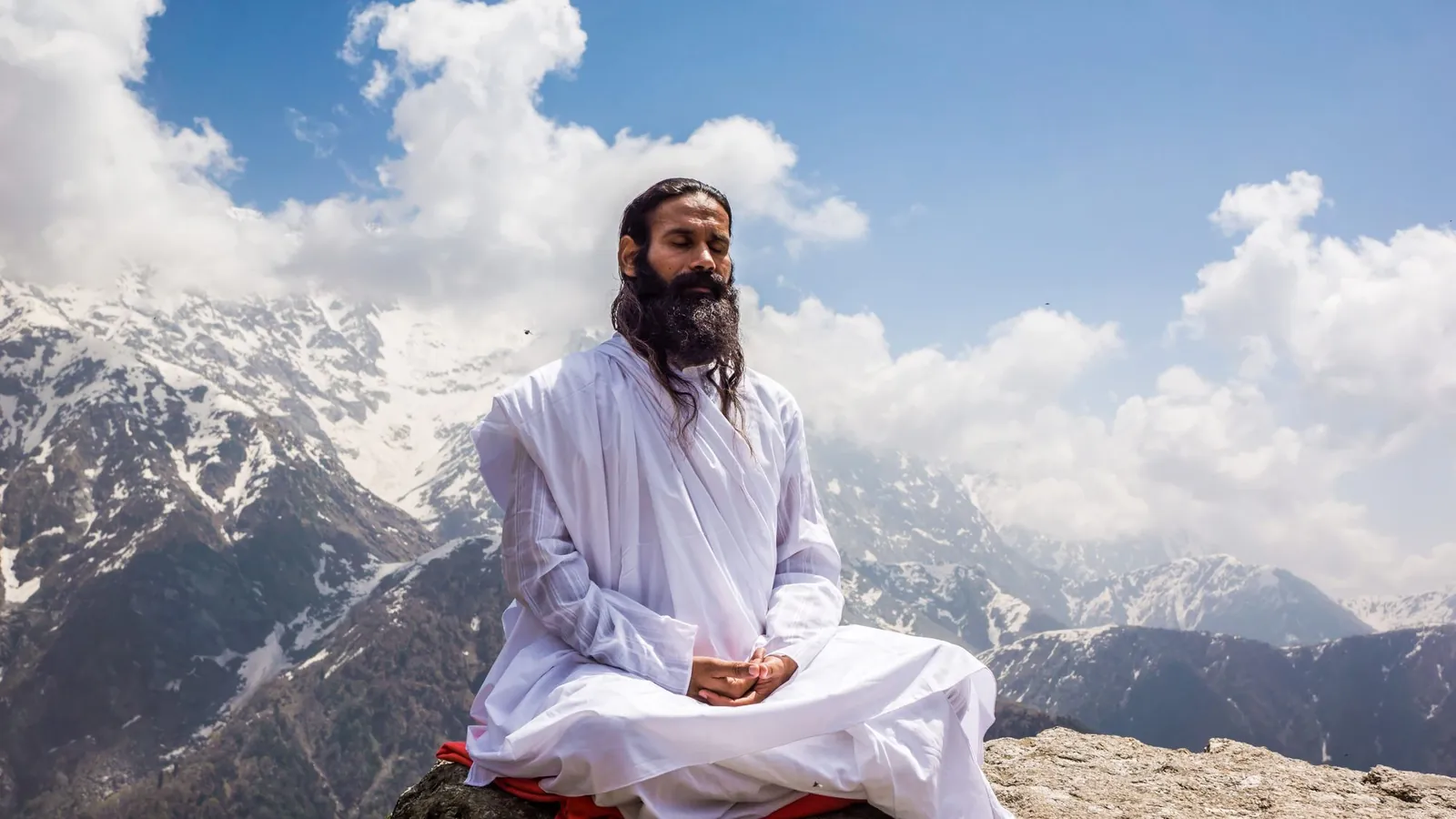
Before closing one’s eyes, establishing the correct physical posture is essential for minimizing bodily distractions and conserving subtle energy.
The four essential steps of physical posture
- Comfortable seating: Choose a quiet, comfortable location. You may sit on the floor upon a mat or cushion, or sit upright in a chair. The primary objective is to maintain a posture where the body can remain relaxed and stationary without discomfort.
- Crossed legs: Cross your legs at the ankles or sit in a comfortable cross-legged position. Crossing the limbs forms a closed circuit within the physical and energetic bodies, preventing subtle life force (Prana) from leaking outward through the extremities.
- Interlocked fingers (Kalyana mudra): Clasp your hands together and interlock your fingers, allowing them to rest comfortably in your lap. This gesture completes the inner energy loop, stabilizing the nervous system.
- Closed eyes: Gently close your eyes and keep them closed throughout the duration of the session. Because approximately eighty percent of sensory perception is processed through visual channels, closing the eyes instantly redirects awareness from the external world into the inner realm.
3. The energetic mechanics: from mind-stillness to cosmic healing
To understand why Anapanasati produces remarkable transformation, one must examine the energetic chain reaction that occurs when the mind achieves stillness. In Maharshi Patanjali’s classic Yoga Sutras, meditation is defined as Chitta Vritti Nirodha, the complete cessation of mind chatter and thought waves.
In normal daily activity, the human mind generates an uninterrupted stream of thousands of thoughts. Each thought acts as an energy drain, dissipating vital energy and keeping the physical body in a state of subtle tension. When a practitioner focuses entirely on the natural breath, the thought stream gradually slows down and eventually comes to a complete standstill.
The subtle energetic chain reaction unfolds through four progressive stages:
- Breath-mind synchronization: Focusing on the natural, unforced breath diverts attention away from external worries, memories, and projections.
- Attainment of the no-mind state: As thought waves vanish, the mind enters a state of absolute stillness (Nirvishaya Manas).
- Influx of cosmic energy (Prana Shakti): In the absence of mental noise, the subtle energy body opens like an antenna, receiving vast torrents of universal cosmic energy through the crown center.
- Cellular replenishment and self-healing: As cosmic energy saturates the subtle channels (Nadis), physical blockages dissolve, toxic karma is cleansed, and the body’s innate self-healing mechanisms are fully activated.
4. Practical guidelines: the age-minute duration framework
A common question among new practitioners is: How long should I meditate each day? To address this, Brahmarshi Pitamaha Patriji introduced a simple, personalized duration formula based on physical age.
The foundational rule mandates that a practitioner should meditate for a minimum number of consecutive minutes equal to their age in years.
- For children (e.g., 10 years old): 10 consecutive minutes per session.
- For young adults (e.g., 25 years old): 25 consecutive minutes per session.
- For adults (e.g., 50 years old): 50 consecutive minutes per session.
- For experienced seekers & masters: 1 to 3 hours or more of deep, uninterrupted meditation.
Consistency is far more vital than sporadic intensity. Meditating daily at the same time and place establishes a powerful rhythmic momentum in the subconscious mind, making it progressively easier to enter deep meditative states.
5. What not to do during Anapanasati meditation
To preserve the purity and effectiveness of the practice, Brahmarshi Pitamaha Patriji explicitly highlights common pitfalls that derail beginner meditators. Many traditions mix meditation with external rituals, which can create mental clutter rather than mental silence.
Practitioners must strictly avoid the following five common mistakes:
- No chanting of mantras: Chanting Om or sacred names keeps the verbal and auditory centers of the brain active, preventing the mind from reaching complete silence.
- No visualization of deities or forms: Imagining figures, lights, or symbols engages the visual imagination, creating new mental thoughts rather than silencing existing ones.
- No breath manipulation: Never perform Pranayama techniques such as fast breathing, deep breathing, or holding the breath (Kumbhaka). Allow the body to breathe at its own natural pace.
- No special physical mudras: Avoid complex hand gestures like Jnana Mudra or Chin Mudra that cause physical fatigue in the fingers. Stick exclusively to simple interlocked fingers (Kalyana Mudra).
- No forced concentration: Meditation is not strained concentration (Dharana); it is relaxed, gentle, effortless observation (Dhyana) of what already is, the natural breath.
6. The three golden pillars of a spiritual life
While daily meditation is the core engine of transformation, Brahmarshi Pitamaha Patriji teaches that meditation alone is incomplete without supporting lifestyle habits. True spiritual progress rests upon three golden pillars that harmonize one’s internal realization with external living.
| Golden pillar | Core practice | Key transformation |
|---|---|---|
| 1. Dhyanam | Daily Anapanasati Meditation | Silences thought waves (Chitta Vritti Nirodha) and recharges cosmic energy |
| 2. Ahimsa | Pure Vegetarianism & Compassion | Cleanses heavy karmic baggage and elevates physical vibrational frequency |
| 3. Swadhyaya & Satsang | Reading Sacred Masterworks & Spiritual Fellowship | Sharpens spiritual discrimination (Viveka) and sustains inner inspiration |
1. Dhyanam (daily Anapanasati meditation)
Committing to daily breath observation to cultivate mental stillness, recharge cosmic energy, and expand personal self-awareness.
2. Ahimsa (non-violence & pure vegetarianism)
Embracing complete non-violence in thought, word, and deed. Brahmarshi Pitamaha Patriji strongly emphasizes that a vegetarian diet (Shakahara) is an absolute requirement for spiritual elevation. Consuming animal flesh introduces heavy karmic burdens and dense, low-frequency vibrations into the body, blocking subtle energy channels.
3. Swadhyaya and Satsang (sacred reading & spiritual fellowship)
Swadhyaya involves reading authentic spiritual masterworks by realized masters. Brahmarshi Pitamaha Patriji highlights classical texts such as Yogananda’s Autobiography of a Yogi, Swami Rama’s Living with the Himalayan Masters, Richard Bach’s Jonathan Livingston Seagull, and Barbara Ann Brennan’s Hands of Light. Complementing reading with Satsang, discussing spiritual experiences with fellow meditators, keeps one’s inspiration vibrant and grounded.
Conclusion: step into your natural divine potential
Meditation is neither an escape from worldly life nor an esoteric privilege reserved for monks in remote caves. It is the birthright of every human being, a practical, scientific method to restore harmony between body, mind, and spirit.
By sitting comfortably, crossing your legs, interlocking your fingers, closing your eyes, and simply being with your natural breath, you open the doorway to infinite energy, health, and wisdom. Start your practice today for minutes equal to your age, and experience the transformative power of Anapanasati firsthand.
0 views