
Humanity has long pondered a fundamental question: What is the ultimate purpose of human life?
While modern society often measures success through financial wealth, social status, professional titles, and material possessions, spiritual science offers a vastly deeper perspective. According to Brahmarshi Pitamaha Patriji, founder of the Pyramid Spiritual Societies Movement (PSSM), the true goal of life (Jeevitha Gamyam) is not material accumulation, but the conscious evolution of the soul from ignorance to self-realization, and ultimately to divine consciousness.
In his profound discourses, Brahmarshi Pitamaha Patriji dismantles common misconceptions about fate, suffering, and spirituality. He presents a scientific, experiential framework that empowers every individual to recognize their innate divinity and take full responsibility for their life’s journey.
1. The three stages of consciousness: from animal to divinity
To understand the ultimate goal of human existence, Brahmarshi Pitamaha Patriji outlines the evolutionary continuum through which consciousness ascends. Every living entity progresses through three distinct states of awareness:
- Pashutvam (the animal state): At this foundational level, consciousness is governed strictly by physical instincts and survival drives, eating, sleeping, self-defense, and reproduction. An entity in Pashutvam reacts impulsively to external stimuli without introspecting on the deeper cause of its experiences.
- Manavatvam (the human state): Human birth marks a pivotal transition. In Manavatvam, intellect (Buddhi) and self-awareness emerge. A human being gains the capacity to question: “Who am I? Why am I here? What is the cause of my suffering?” However, if a human remains consumed solely by sensory pleasures and material desires, Brahmarshi Pitamaha Patriji notes that they live merely in a human body while remaining psychologically stuck in Pashutvam.
- Madhavatvam (the divine state): The ultimate purpose of human life is to transcend Manavatvam and realize Madhavatvam, the direct, experiential knowing that one is not merely a physical body or finite mind, but an eternal, omniscient soul (Atma). At this stage, individual consciousness aligns with universal consciousness (Sarvatma).
“Human birth is a rare opportunity to transform Manavatvam into Madhavatvam. When you realize that all that exists is the soul, you step out of animalistic fear and into divine freedom.”
Brahmarshi Pitamaha Patriji
2. Swa-Ichha and Tathastu: the sovereignty of the soul
A cornerstone of Brahmarshi Pitamaha Patriji’s teaching is the absolute freedom and sovereignty of the soul (Swa-Ichha). Contrary to the belief that human beings are victims of an arbitrary cosmic fate, spiritual science reveals that every soul actively chooses its life experiences for its own learning and expansion.
The cosmic principle of Tathastu
The universe operates under the eternal law of Tathastu (“So be it”). The cosmic consciousness does not judge, punish, or reward; rather, it responds with an unconditional “Tathastu” to the deep intentions and choices of every soul.
| Principle | Spiritual concept | Practical meaning |
|---|---|---|
| Swa-Ichha | Soul’s Free Will | Every experience, challenge, and role in life is chosen by the soul for its evolution. |
| Tathastu | Cosmic Acquiescence | The universe grants and manifests whatever the soul deeply intends and seeks. |
| Jivatma to Sarvatma | Self-Realization | The realization that the individual soul (Jivatma) is identical to the universal spirit (Sarvatma). |
The cinema analogy: actor vs. character
To illustrate Swa-Ichha and Tathastu, Brahmarshi Pitamaha Patriji uses the vivid analogy of an actor in a feature film or a theatrical play.
Everyday Example: Consider a world-renowned actor who plays a tragic character in a drama or a villain in a blockbuster movie. On screen, the character may suffer defeat, betrayal, or heartbreak. However, off screen, the actor chose the role enthusiastically to display their artistry. The director does not force the actor; the actor willingly signs up for the script.
Similarly, your soul (Jivatma) chooses its specific life circumstances, including hardship, family background, and challenges, to gain specific spiritual lessons. When you realize you are the eternal actor (Atma) rather than the temporary movie character (Body/Mind), suffering immediately loses its sting.
3. The law of cause & effect (Karya Karana Sambandham)
A central pillar in realizing life’s purpose is understanding the Law of Cause and Effect (Karya Karana Sambandham). Brahmarshi Pitamaha Patriji delivers a striking reminder regarding human suffering:
“The depth of your belief in injustice and tragedy is the exact measure of your ignorance.”
Brahmarshi Pitamaha Patriji
When we lack spiritual vision, we look at life’s hardships and cry, “Why did this happen to me? Life is so unfair!” But in a universe governed by perfect cause and effect, there are no accidents, no undeserved tragedies, and no unearned rewards.
The four degrees of Karma cancellation
When an individual takes up deep meditation (Anapanasati), they begin to clear past karmic burdens. Brahmarshi Pitamaha Patriji categorizes karma cancellation into four distinct degrees:
- First degree (physical symptoms & friction): During initial meditation, stored karmic energies release as mild physical restlessness, body heat, or slight discomfort.
- Second degree (mental & emotional cleansing): Past memories, suppressed emotions, and unfulfilled desires surface to be acknowledged and dissolved in awareness.
- Third degree (dissolution of major karmic blocks): Deep-seated karmic patterns (Sanchita Karma) that would otherwise manifest as severe life crises or chronic illness are neutralized through spiritual energy (Prana).
- Fourth degree (complete liberation / Nirvana): Total transcendence of karmic causation. The soul enters a state of perpetual clarity, liberation, and wisdom (Moksha).
4. Pure meditation (Anapanasati): the direct path to purpose
How does one bridge the gap between theoretical knowledge and direct realization? Brahmarshi Pitamaha Patriji stresses that intellectual reading alone cannot transform consciousness, Meditation (Dhyana) is essential.
What is pure meditation?
Brahmarshi Pitamaha Patriji advocated the ancient technique of Anapanasati, simple, natural breath awareness:
- Ana: In-breath
- Apana: Out-breath
- Sati: Being one with
Unlike ritualistic practices that involve chanting mantras, visualizing forms, or performing complex austerities, Anapanasati requires zero artificial effort:
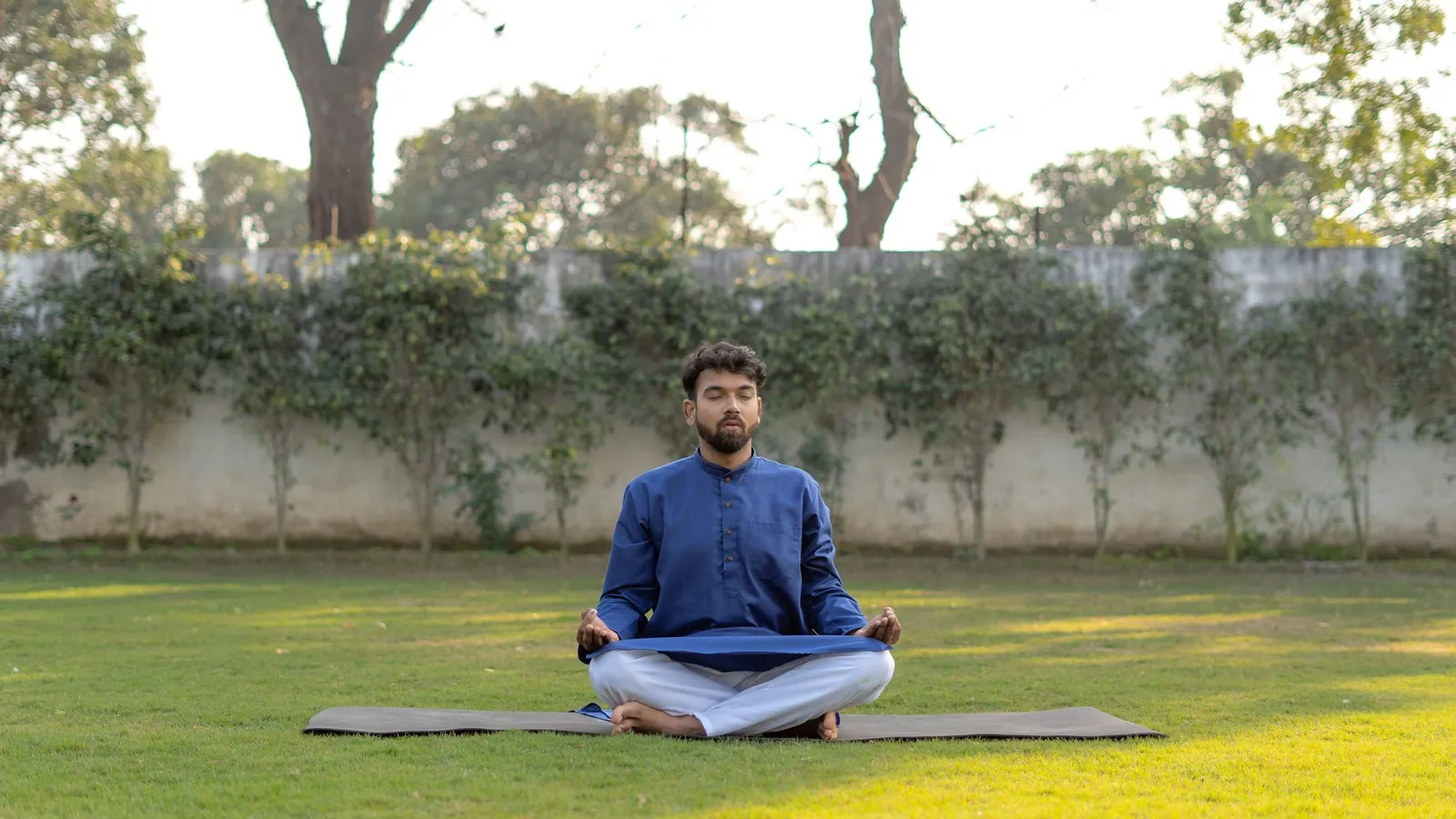
- Comfortable posture: Sit comfortably with fingers clasped and eyes gently closed.
- Natural breath: Observe the natural, normal flow of the incoming and outgoing breath.
- Mind stillness: When thoughts arise, gently bring attention back to the breath without judgment.
Meditation for its own sake
Brahmarshi Pitamaha Patriji strongly cautions against commercializing or bartering with meditation. True meditation is not a business transaction where one bargains with the divine for financial favors, job promotions, or worldly cures.
“Do meditation purely for the sake of meditation. There are no commercial guarantees in true spirituality. When you sit in silence, you connect with your inner soul energy, and that wisdom naturally harmonizes all aspects of your life.”
Brahmarshi Pitamaha Patriji
5. Practical pillars for fulfilling life’s purpose
To maintain spiritual progress and fulfill the goal of human life, Brahmarshi Pitamaha Patriji outlined four indispensable lifestyle practices:
| Pillar | Practice | Purpose & application |
|---|---|---|
| 1. Dhyana (meditation) | Anapanasati Breath Awareness | Practice daily breath observation (minutes equal to your age) to build inner energy. |
| 2. Swadhyaya (self-study) | Wisdom of Realized Masters | Nourish the intellect with spiritual literature to reinforce truth. |
| 3. Sajjana sangatya | Spiritual Fellowship | Spend time with fellow meditators to accelerate personal growth and stay grounded. |
| 4. Shakahara (vegetarianism) | Compassionate Living | Maintain a plant-based diet to align personal energy with non-violence (Ahimsa). |
Conclusion: awakening to your true potential
The goal of life is not a distant destination or an external reward; it is an inner awakening. You are not a helpless creature adrift in a chaotic world, but a divine soul (Atma) possessing Swa-Ichha (free will), living in a universe of perfect cause and effect.
By embracing Anapanasati meditation, living with scientific inquiry, and practicing compassion toward all beings, you move seamlessly from Pashutvam to Manavatvam, and ultimately fulfill your highest potential: Madhavatvam, living as a fully realized, joyful, and liberated divine master.
0 views