
In an increasingly complex world marked by rapid urbanization, mental restlessness, and digital distraction, achieving genuine peace of mind and bodily health requires more than temporary fixes.
In his foundational discourse Dhyanam Valla Labhalu (The Benefits of Meditation), Brahmarshi Pitamaha Patriji lays out a comprehensive framework that positions meditation not as an esoteric religious practice, but as an essential, universal science of life (Jeevana Shastram).
1. Jeevana Shastram: the master science of life
Human society places tremendous emphasis on specialized domain sciences. To excel in agriculture, one studies soil fertility, seed selection, and climate conditions in agricultural science. To succeed in business, one pursues commercial degrees like an MBA to master management and market dynamics. To become an accomplished musician, one undergoes years of rigorous training under a master to learn ragas, talas, and harmony, far beyond casual bathroom singing.
However, while domain sciences teach individuals how to earn a living or master specific skills, they do not teach individuals how to live correctly. Brahmarshi Pitamaha Patriji asserts that there is a supreme umbrella discipline: Jeevana Shastram (Spiritual Science or the Science of Life).
Spiritual Science addresses fundamental existential questions: What is birth? What is death? Who am I before birth and where do I go after death? How can I live with joy, health, and harmony alongside my fellow human beings?
Throughout history, great masters have functioned as spiritual scientists. Albert Einstein mastered physics, Bismillah Khan mastered the shehnai, and Ravi Shankar mastered the sitar. Similarly, seers like Gautama Buddha, Jesus Christ, Veda Vyasa, Valmiki, Kabir, Vemana, Master CVV, Master EK, Guru Nanak, Lao Tzu, and modern spiritual authors like Lobsang Rampa, Paramahansa Yogananda, Swami Rama, Kahlil Gibran, Barbara Ann Brennan, Linda Goodman, and Richard Bach operated as scientists of Jeevana Shastram. They experimented with their own consciousness through meditation, decoded universal spiritual laws, and shared their empirical discoveries with humanity.
2. The core philosophy & ideal principles of Pyramid Spiritual Societies
To distill the vast ocean of spiritual wisdom into practical guidelines, the Pyramid Spiritual Societies Movement (PSSM) established a set of Ideal Principles. These principles guide individuals away from superficial rituals toward authentic spiritual transformation.
| Principle tier | Key ideals & spiritual practices | Operational meaning & purpose |
|---|---|---|
| Foundational practices | Right Meditation (Saraina Dhyanam) | Practicing true breath awareness (Anapanasati) without mantras or ritualistic distractions. |
| Spiritual reading (Swadhyaya) | Studying classic spiritual masterworks (such as Autobiography of a Yogi, Living with the Himalayan Masters, The Prophet, and You Forever) that reveal cosmic laws. | |
| Experience sharing (Satsang) | Sharing meditative experiences and spiritual insights with fellow seekers. | |
| Personal discipline | Restraint of Speech (Maunam) | Speaking only when necessary to conserve vital energy (Prana Shakti). |
| Full moon meditation (Pournami Dhyanam) | Meditating intensely during full moon nights when cosmic energy inflow is heightened. | |
| Early childhood meditation | Initiating children into meditation early, following examples like Prahlada, Dhruva, and Swami Vivekananda. | |
| Environmental & social | Pyramid Meditation | Meditating inside pyramid structures to amplify energy absorption. |
| Free instruction (Nishulkam) | Teaching meditation purely out of selfless service, without charging any fees. | |
| Friendship over hierarchy | Eradicating guru-disciple power dynamics in favor of spiritual friendship (Friendly Buddha). | |
| Simplicity of attire & language | Avoiding saffron robes, ostentatious symbols, or complex jargon; using plain everyday speech. | |
| Life integration | Householder Enlightenment (Gruhastha Jeevanam) | Achieving liberation within family life (Samsarame Nirvana), balancing 12 hours of worldly work with 12 hours of spiritual awareness. |
| Self-reliance & self-healing | Utilizing inner soul power to overcome physical illnesses and personal challenges without external dependence (Uddhared Atmanatmanam). |
3. Understanding Dhyanam: mechanics of mind emptiness
At its core, meditation (Dhyanam) is defined by Maharshi Patanjali in the Yoga Sutras as Chitta Vritti Nirodha, the complete cessation of mental fluctuations, or simply making the mind empty.
To understand why mind emptiness is vital, consider everyday household appliances and physical organs:
- The electric fan & light bulb: If an electric fan or light bulb is kept running continuously for 24 hours a day without a break, the mechanism overheats and burns out. Switched-off rest periods are mandatory for longevity.
- Vocal cords & physical body: If a person speaks continuously without stopping, the vocal cords suffer damage. If the body is moved continuously without sleep, it collapses. Nightly sleep provides physical rest.
- The mind & brain: The human mind is continuously processing thousands of thoughts every single day regarding past regrets, future anxieties, financial burdens, and family obligations. Without intentional rest, the mental “fuse” blows, leading to premature aging, disease, and mental exhaustion.
Meditation is compulsory rest for the mind. Just as sleep is non-negotiable for physical recovery, meditation is non-negotiable for mental and spiritual rejuvenation.
4. Right meditation (Anapanasati) vs. popular misconceptions
Brahmarshi Pitamaha Patriji emphasizes that while there are thousands of distorted meditation practices, there is only one natural, effective method: Anapanasati Dhyanam, as originally taught by Gautama Buddha and ancient seers.
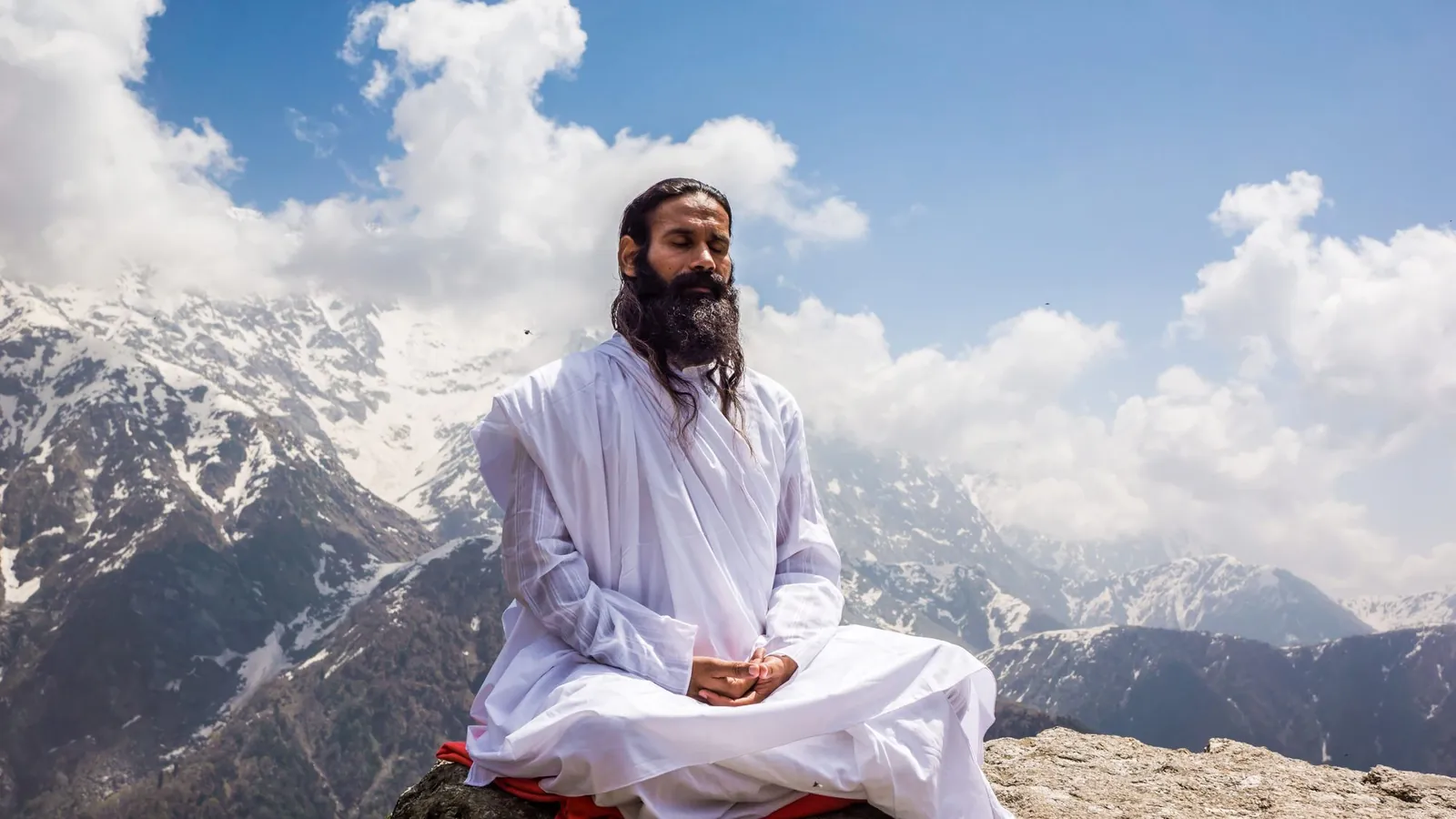
The correct posture (Dhyana mudra)
Patanjali defined posture as Sthira Sukham Asanam, a posture that brings stability and comfort.
- Comfortable seating: Sit comfortably on a chair or the floor. There is no requirement to force oneself into rigid postures like Padmasana (Lotus pose) or strain the spine unnaturally. Support from a wall, chair back, or tree is completely acceptable.
- Crossed legs: Cross the feet or ankles comfortably to seal the body’s energy circuit.
- Clasped fingers: Interlock all fingers of both hands together and let them rest comfortably in the lap.
- Closed eyes: Gently close both eyes to cut off external visual inputs.
The core technique (Anapanasati)
The word Anapanasati is derived from three Pali/Sanskrit roots:
- Ana: In-breath (Uchwasa)
- Apana: Out-breath (Nishwasa)
- Sati: Being united or together with
The practitioner simply observes the natural, soft, effortless flow of the incoming and outgoing breath (Swasanusandhanam).
Common misconceptions to avoid
- No mantras: Repeating words or sounds like Om, Soham, or Ram engages the vocal and mental apparatus, preventing complete mental emptiness.
- No visualizations: Imagining forms of deities, light centers, or external symbols keeps the mind active in thought creation.
- No forced breathing: Practices involving breath retention (Kumbhaka) or violent inhalation/exhalation are unnatural and strain the nervous system.
5. The duration rule and practice environment
To achieve tangible spiritual results, meditation must be practiced with appropriate duration and environmental awareness.
The age-minute formula
Brahmarshi Pitamaha Patriji recommends a simple, critical minimum threshold: Meditate for a number of minutes equal to your age in years.
- A 5-year-old child should meditate for 5 minutes.
- A 20-year-old should meditate for 20 minutes.
- A 50-year-old adult should meditate for 50 minutes.
- A 70-year-old elder should meditate for 70 minutes.
Just as rice requires a specific cooking time on the stove to become tender, the mind requires a minimum uninterrupted duration to settle from high-frequency chatter into complete tranquility.
Environment & practical tips
- Darkened spaces: Draw curtains or switch off lights. Ancient rishis retreated to dark caves because darkness minimizes sensory stimulation.
- Leveraging travel time: Long journeys by train, bus, car, or airplane provide ideal opportunities for extended meditation. Closing one’s eyes and observing the breath during travel turns idle transit hours into profound energy accumulation.
6. The three fundamental laws of meditation
The process of spiritual transformation through Anapanasati follows three precise, verifiable laws of energy mechanics:
- Law 1: Swasanusandhanam → Chitta Vritti Nirodha: When awareness is continuously anchored to the natural breath, the frequency of thoughts drops from 100 thoughts per minute down to 80, 60, 20, 2, and finally zero, achieving complete mind emptiness.
- Law 2: Chitta Vritti Nirodha → Viswa Shakti inflow: When the mind becomes completely still and empty, the energetic barrier created by constant thought chatter dissolves. Universal Cosmic Energy (Viswa Shakti) pours into the physical and subtle bodies like a torrential cosmic rainstorm, cleansing energetic blockages and rejuvenating every cell.
- Law 3: Viswa Shakti inflow → activation of Siddhis & Divya Chakshu: As cosmic energy saturates the subtle channels, latent spiritual capacities (Siddhis) blossom naturally. The Third Eye (Divya Chakshu) awakens, inner vision opens, self-healing accelerates, and the practitioner gains profound clarity regarding their life’s purpose and soul journey.
The allegory of Hanuman Chalisa
Brahmarshi Pitamaha Patriji decodes the spiritual symbolism of the ancient Hanuman Chalisa:
- Hanuman: Represents Vayu Putra (the Son of Breath/Wind), the spiritual practitioner who masters the breath.
- Chalisa: Refers to 40 days of dedicated discipline (or 40 minutes of deep meditation).
A practitioner who engages in continuous breath mastery for 40 days transforms their mortal limitations into divine strength, evolving into a true master (Yogi).
7. Conclusion: practice makes man perfect
Spiritual realization is not achieved through intellectual debate, external rituals, or decorative attire; it is earned solely through daily practice. As the classic adage states: Practice makes man perfect, and the practice of meditation makes man spiritually perfect.
By embracing Anapanasati Dhyanam, honoring the ideal principles of right living, and devoting daily time to mind emptiness, every individual can unlock their inherent divine potential, achieve lasting physical health, and live as a master of their own destiny.
0 views