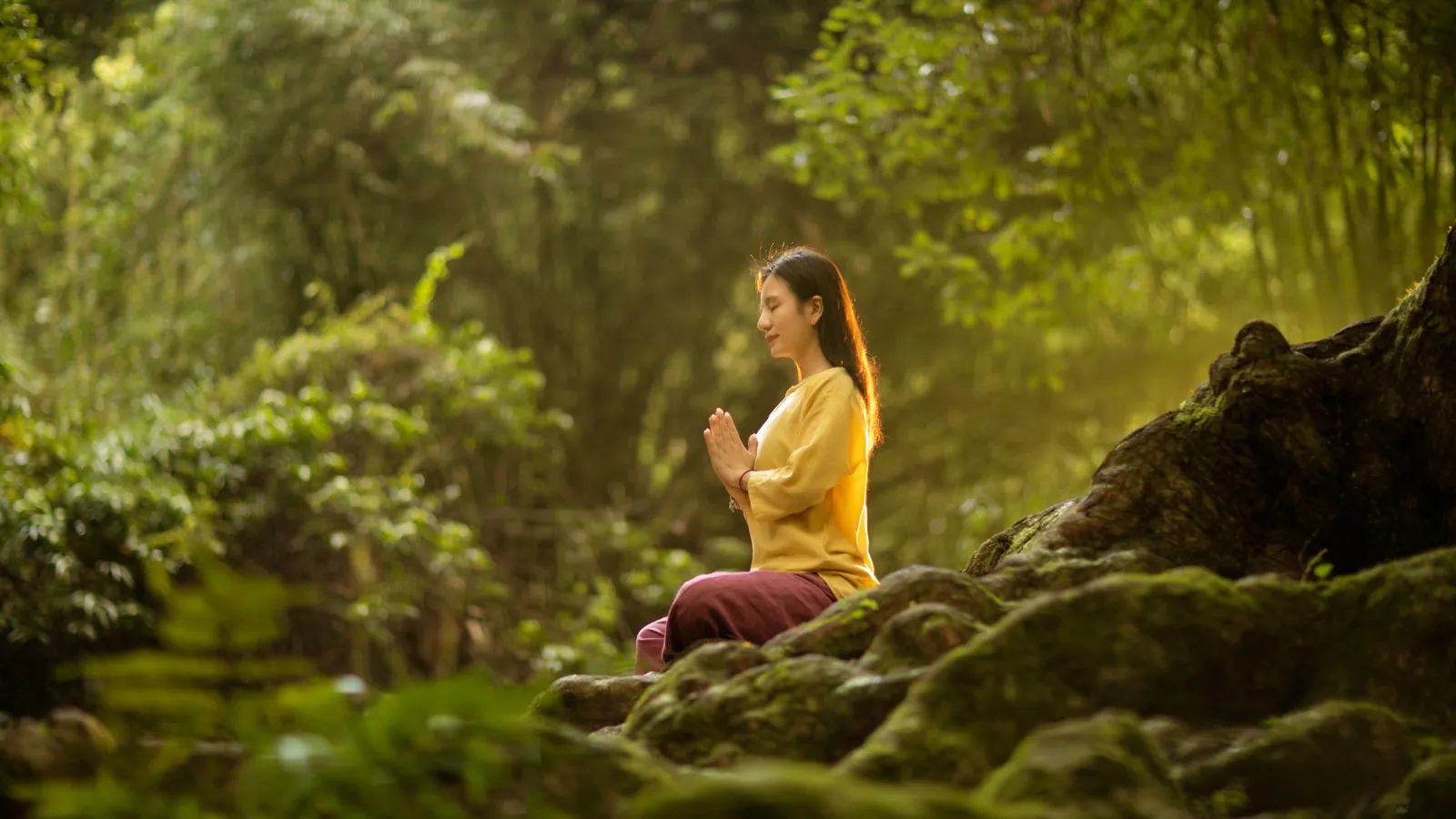

Human existence in the modern era is often characterized by relentless mental activity, emotional friction, and an endless search for external remedies to internal suffering.
In his profound discourse on the benefits of meditation, Dhyanam Valla Labhalu, Brahmarshi Pitamaha Patriji lays bare a fundamental truth: while living without meditation results in endless losses across every dimension of life, practicing natural breath awareness yields limitless physical, psychological, and spiritual rewards. Meditation is not an optional hobby or a mere relaxation technique; it is the fundamental rest required by the mind to replenish cosmic energy, align karmic patterns, and realize divine human potential.
1. Reversing aging and reclaiming physical vitality
The physical body is directly governed and sustained by the subtle energy of the mind. When the mind is constantly agitated by unceasing thoughts, worry, and desires, its energy is rapidly drained, leaving the physical body depleted and vulnerable to premature decay.
Brahmarshi Pitamaha Patriji explains that while sleep provides partial rest to the physical body, true rest for the mind occurs only when thought activity completely ceases through meditation. Without this deep mental rest, young adults in their thirties often exhibit the physical exhaustion, frailty, and worn facial features of individuals in their sixties. Conversely, a dedicated meditator at age fifty or sixty retains the radiant skin, high energy, and mental agility of a person in their twenties or thirties.
By practicing regular meditation, individuals gain conscious mastery over the dual inevitabilities of physical existence: Jara (old age) and Marana (death). Rather than living a life dragged down by chronic exhaustion and fearing an untimely demise, a meditator extends their lifespan, maintains youthful vigor, and lives with dynamic enthusiasm.
2. The spiritual science of health: eradicating disease at the karmic root
Conventional medical systems view illness primarily as an invasion of external pathogens or a failure of biological hardware. Spiritual science, however, reveals a deeper diagnostic principle encapsulated in ancient Vedic wisdom:
“Purva Janma Krutam Papam Vyadhi Rupena Peedithe” (The negative karmas performed in past lives manifest as physical diseases and suffering in the present life.)
Ancient Vedic wisdom
Physical ailments are not accidental; they are the precise energetic reflection of past unrighteous deeds and violent actions. External pathogens like bacteria and viruses are merely microscopic catalysts, comparable in importance to a tiny mustard seed, whereas the underlying karmic cause and spiritual laws are as vast as an elephant.
The limitations of medical palliative care vs. cosmic healing
Conventional medical treatments, whether Allopathy, Ayurveda, or Homeopathy, operate solely at the physical level. They offer temporary palliative relief, suppressing symptoms while leaving the underlying karmic seed intact. Consequently, ailments frequently recur or manifest in alternative physical forms.
True healing occurs when the karmic seed is burned away in the fire of spiritual wisdom (Jnana Agni). When an individual enters deep meditation, thought activity halts, creating an inner void that allows an abundant inflow of universal cosmic energy. This cosmic energy purifies the subtle energy channels (Nadis), dissolves karmic imprints, and permanently eradicates disease from its source.
As Lord Krishna declares in the Bhagavad Gita: Uddhared Atmanatmanam, each individual must elevate and heal themselves through their own inner effort. External doctors cannot bestow spiritual energy; it must be drawn directly from the cosmos through self-initiated meditation.
3. The ethical shift: from violence (Himsa) to divinity (Devata)
A direct consequence of regular meditation is the spontaneous transformation of personal habits, dietary choices, and moral tendencies. Physical health and karmic purity are inextricably linked to the food one consumes.
Non-vegetarian food, including meat, poultry, fish, and eggs, is categorized as Raksasa Bhojanam (food of demonic nature), as it involves the brutal killing and suffering of living beings. Ingesting the fear and agony of slaughtered animals fills the human body with dense, negative energies that breed disease and mental turbulence.
- Raksasa Bhojanam (demonic dietary state): Consuming animal flesh and non-vegetarian foods born of killing and animal suffering.
- Manava Bhojanam (human dietary state): Adopting a pure, compassionate vegetarian diet (Sakahara) that respects all living creatures.
- Devata Bhojanam (divine energy state): Feasting directly on universal cosmic life force through breath observation (Svasahara).
Meditation awakens latent spiritual sensitivity, instilling the core principle of Ahimsa (non-violence). Brahmarshi Pitamaha Patriji summarizes this evolutionary shift in a powerful motto:
“Himsa Chodiye, Hamsa Pakadiye” (Abandon violence toward living beings; cling to ‘Hamsa’, the sacred breath.)
Brahmarshi Pitamaha Patriji
Through meditation, a person who once engaged in violent habits or consumed non-vegetarian food naturally loses the inclination for meat and embraces a pure vegetarian diet (Sakahara). As practice deepens, the soul progresses further to feast directly on cosmic energy (Svasahara). This inner shift transforms demonic tendencies into human refinement, and human consciousness into divine self-realization (Paramahamsa).
4. Academic and cognitive mastery for students
For students and young professionals, meditation is the single most potent tool for intellectual excellence. Academic failure and learning difficulties do not stem from a lack of intelligence, but from a cluttered, distracted mind.
The analogy of the filled glass
Consider a glass that is already filled with tea. If one attempts to pour fresh coffee into it, the coffee will spill over and be wasted. Similarly, if a student sits in a classroom while their mind is filled with thoughts of movies, sports, family conflicts, or personal anxieties, the teacher’s instructions cannot enter the mind.
Meditation trains the mind to achieve a state of conscious emptiness (Shunyata). By practicing just five to twenty minutes of daily breath awareness, students cultivate four major cognitive faculties:
- Concentration (Ekagrata): The ability to focus single-mindedly on a subject without internal drift.
- Single-hearing absorption (Eka Santha Grahi): The capacity to grasp complex concepts completely upon hearing them once.
- Enhanced memory power (Jnapaka Shakti): Effortless retention and recall of studied material during examinations.
- Fearless execution: Complete elimination of pre-exam jitters, nervousness, and sweating during critical tests or job interviews.
By sitting quietly in breath observation prior to an exam or interview, anxiety dissolves, allowing clear thinking and optimal performance.
5. Unshakable inner peace in everyday life
Human life is replete with interpersonal friction, whether within families, workplaces, or societal structures. Individuals often possess wealth, education, and social status, yet remain completely devoid of inner peace due to emotional conflicts and mismatched egoic expectations.
Brahmarshi Pitamaha Patriji emphasizes that external circumstances cannot be controlled, but one’s internal state can be fully mastered through meditation. When emotional storms brew, closing one’s eyes and observing the natural breath for ten to twenty minutes immediately restores mental equilibrium.
The contrast of Arjuna and Lord Krishna in Mahabharata
The epic Kurukshetra war illustrates the profound difference between a non-meditator and a master of inner stillness:
- Arjuna’s emotional collapse: When confronted with fighting his relatives, teachers, and kinsmen, Arjuna was overcome with severe grief (Vishada), dropped his mighty bow Gandiva, wept, and expressed a desire to renounce his duty and live as a beggar. Lacking meditative mastery over his mind, he collapsed into paralysis despite being a world-class warrior.
- Lord Krishna’s unshakable composure: Lord Krishna, a supreme yogi and master of inner stillness, stood in the very same battlefield with absolute calm, a radiant smile, and undisturbed joy. He guided Arjuna without a single trace of personal sorrow or mental agitation because his consciousness remained rooted in eternal truth.
| Aspect | Arjuna (non-meditator state) | Lord Krishna (master yogi state) |
|---|---|---|
| Response to conflict | Overwhelmed by grief, anxiety, and paralysis | Absolute equanimity, clarity, and decisive action |
| Internal equilibrium | Dropped his bow (Gandiva) and wished to beg | Maintained a radiant smile and undisturbed joy |
| Mind state | Cluttered with personal attachments and fear | Anchored in cosmic truth and mind stillness |
True peace of mind cannot be purchased with money, nor can it be attained through physical rituals, chanting stotras, or performing sacrifices. It is achieved solely through the practice of mind-emptiness (Chitta Vritti Nirodha) via Anapanasati meditation.
6. Daily practice commitment: the path to perfection
Spiritual mastery is not an accidental occurrence; it is the direct result of persistent, disciplined practice. As the universal maxim declares: “Practice makes man perfect.”
To harvest the limitless benefits of meditation, reversal of aging, freedom from physical ailments, eradication of negative habits, heightened intelligence, and unshakeable inner peace, one must dedicate time daily to quiet breath observation. By closing the eyes, interlocking the fingers, crossing the legs, and aligning with the natural rhythm of the in-breath and out-breath, every individual can step out of darkness and claim their birthright of cosmic health, wisdom, and liberation.
0 views