
In an era driven by constant hustle, instant gratification, and material pursuits, spiritual master Brahmarshi Pitamaha Patriji presents a profound paradigm shift: Time is not money, Time is Practice (Samayam Sadhana), and Patience is the true Wealth (Sahanam Dhanam).
Grounded in ancient wisdom and practical spiritual science, Brahmarshi Pitamaha Patriji’s teachings offer a lucid roadmap for navigating human life, understanding soul sovereignty, and attaining ultimate liberation (Moksha).
This blog post explores Brahmarshi Pitamaha Patriji’s core message, examining how free will (Swa-Ichha), cosmic reflection (Tathastu), lifetime role-playing, and pure breath-focused meditation (Anapanasati) converge to awaken divine consciousness within every human being.
1. Samayam Sadhana, Sahanam Dhanam: redefining life’s true currency
In ordinary worldly life, time is frequently treated as a commodity to be traded for financial gain or spent on fleeting entertainment. However, spiritual science reveals that time is the primary asset bestowed upon the soul to engage in spiritual practice (Sadhana). When time is dedicated daily to inner observation, self-inquiry, and meditation, it transforms from ordinary duration into spiritual evolution.
Equally transformative is the concept of patience (Sahanam). While material wealth (Dhanam) consists of temporary assets that can be lost, stolen, or depleted, patience represents an imperishable internal wealth. It is the capacity to endure life’s fluctuating circumstances, trials, and dualities with unwavering equanimity and poise.
“Time is given for practice (Sadhana), not for distraction. Patience (Sahanam) is the ultimate wealth that no external force can take away from you.”
Brahmarshi Pitamaha Patriji
The contrast between conventional worldly priorities and spiritual priorities highlights how shifting one’s perspective redefines human fulfillment:
| Dimension | Worldly perspective | Spiritual science perspective (Brahmarshi Pitamaha Patriji) |
|---|---|---|
| Primary asset | Financial Capital & Material Possessions | Time Dedicated to Spiritual Practice (Samayam Sadhana) |
| True wealth | Accumulation of Money & Status | Patience & Inner Equanimity (Sahanam Dhanam) |
| Life purpose | Chasing External Achievements | Evolution of Consciousness (Pashutvam to Madhavatvam) |
| Response to trials | Reaction, Blame, & Suffering | Acceptance, Insight, & Karma Resolution |
| Core practice | Seeking External Solutions | Pure Meditation on the Natural Breath (Anapanasati) |
2. Swa-Ichha and the cosmic law of Tathastu: the power of sovereign will
At the foundational core of soul existence lies absolute free will (Swa-Ichha) and ultimate independence (Swa-Tantram). As Brahmarshi Pitamaha Patriji emphasizes, the soul is inherently free, it is neither bound by external compulsion nor subjected to arbitrary cosmic judgment. Every experience, scenario, and life condition is chosen by the soul for its own learning and expansion.
Operating alongside Swa-Ichha is the universal law of Tathastu (“So be it”). The universe functions as a neutral, infinitely responsive cosmic mirror. Whatever desire, belief, or intention an individual holds, the cosmic energy continuously responds with Tathastu:
- Intention & thought generation: The soul formulates a specific desire, thought, or plan, whether to explore a particular role, experience a challenge, or master a virtue.
- Cosmic echo (Tathastu): The divine consciousness bestows sanction without judgment, declaring “So be it” to the soul’s chosen vector.
- Manifestation & experience: The physical world arranges events, encounters, and circumstances to fulfill the chosen script.
- Integration & wisdom: Through experiencing the direct outcomes of its choices, the soul extracts wisdom and advances to higher stages of awareness.
3. The grand theater of existence: life as cinema & soul scripting
To make deep spiritual truths accessible, Brahmarshi Pitamaha Patriji draws a striking parallel to William Shakespeare’s famous declaration:
“All the world’s a stage, and all the men and women merely players.”
William Shakespeare
Extending this to modern storytelling, Brahmarshi Pitamaha Patriji compares human reincarnations (Ananta Janmalu) to a multi-episodic film production or a cinematic blockbuster like Baahubali, the Ramayana, or the Mahabharata.
Consider how an actor operates on a movie set:
- An actor may play a heroic figure like Rama or Arjuna, or a villainous antagonist like Ravana or Duryodhana.
- During shooting, the actor engages fully in intense conflicts, battles, and dramatic dialogues.
- Once the director calls “Cut,” the actor steps off the set, removes the costume, and recognizes that the role was merely an artistic performance.
In exactly the same manner, the eternal soul (Jivatma / Sarvatma) writes its own life scripts, casts fellow souls in supporting roles, and enters physical births to enact specific dramatic scenarios. Recognizing this theatrical reality dissolves bitterness, victimhood, and blame:
“Whether one plays the hero or the villain in life’s drama, both are actors fulfilling a script chosen by soul free will (Swa-Ichha). Understanding this truth brings immediate freedom.”
Brahmarshi Pitamaha Patriji
4. Teeristhe Moksham, Teeyakapothe Bandham: from ignorance to spiritual science
Brahmarshi Pitamaha Patriji summarizes spiritual wisdom in a concise aphorism: “Teeristhe Moksham, Teeyakapothe Bandham“, Knowing is liberation; not knowing is bondage.
When an individual remains ignorant of their divine soul nature, they identify completely with the temporary physical body, mind, and intellect. This ignorance generates fear, suffering, and attachment, creating self-imposed bondage (Bandham). Conversely, when one gains self-knowledge (Atma Jnanam) through spiritual science and meditation, they attain liberation (Nirvana or Moksha) right while living in the physical world.
Human evolution represents a continuous journey across three distinct stages of consciousness:
- Pashutvam (animalistic stage): Living purely by physical instincts, impulse, reactivity, and self-preservation.
- Manavatvam (human stage): Utilizing intellect, logic, ethical reasoning, and social responsibility.
- Madhavatvam (divine stage): Awakening to soul consciousness, universal oneness, and the realization that all that exists is the supreme spirit (Sarvatma).
5. The four pillars of Anapanasati meditation
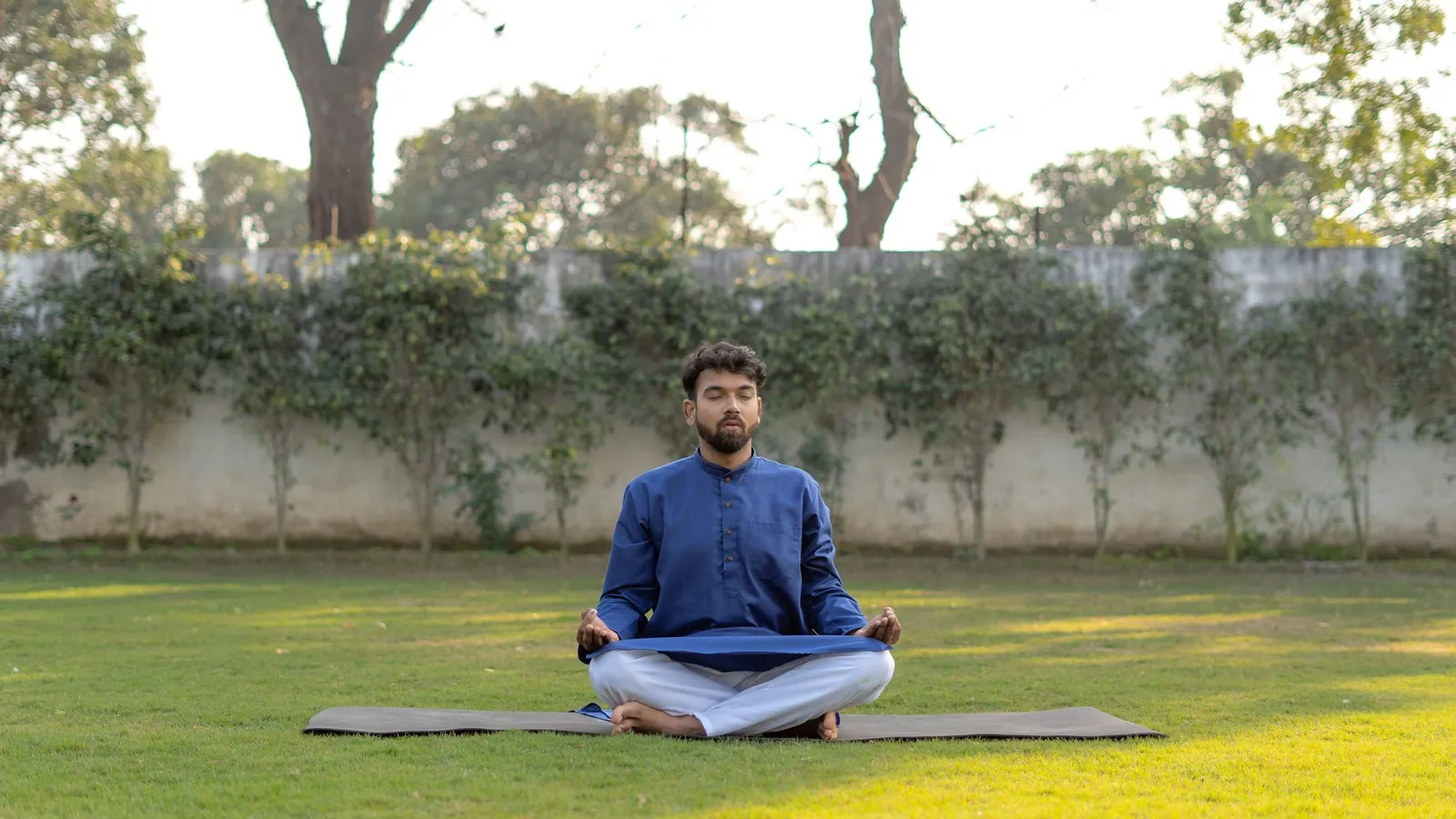
How does one bridge the gap between theoretical knowledge and lived experience? Brahmarshi Pitamaha Patriji insists that the only effective path is the practice of Anapanasati Meditation, the ancient technique of observing the normal, natural, soft, peaceful, and tranquil breath.
Anapanasati requires no complex rituals, mantras, or physical strain. It is simple, tender, and accessible to everyone regardless of background:
- Comfortable posture: Sit in a relaxed position, clasping your fingers together and closing your eyes.
- Breath awareness: Gently unite your attention with the natural flow of incoming and outgoing breath, without forcing or regulating the rhythm.
- Mind stillness: As thoughts arise, gently let them pass and return awareness back to the tranquil breath.
- The fourfold mission: Brahmarshi Pitamaha Patriji encapsulates the duty of every practitioner in four clear directives:
- Learn Meditation (Dhyanam Kooruko)
- Practice Meditation (Dhyanam Cheyyi)
- Teach Meditation (Dhyanam Nerpu)
- Spread Meditation (Dhyanam Pracharam Cheyyi)
6. Summary & actionable takeaways for daily life
Brahmarshi Pitamaha Patriji’s teachings remind us that life is not a series of random tragedies or unjust events, but a purposeful, self-designed journey of soul evolution governed by the Law of Cause and Effect (Karya Karana Sambandham).
Essential takeaways for daily practice
- Invest time wisely: Treat every day as an opportunity for spiritual practice (Samayam Sadhana). Reserve dedicated time each morning and evening for silent breath observation.
- Cultivate patience: Recognize patience (Sahanam) as your greatest spiritual asset. When faced with external turmoil, remain anchored in inner stillness.
- Own your choice: Remember that your soul operated with free will (Swa-Ichha) in choosing your life circumstances. Shift from asking “Why is this happening to me?” to “What is my soul learning from this?”
- Embrace the theater of life: View life’s dualities, challenges, and relationships with the detachment of an actor on a stage, knowing your true identity is the eternal, imperishable soul.
- Share the light: Once you experience the peace of meditation, share the practice with family, friends, and the community.
By dedicating time to practice and acquiring the wealth of patience, every seeker can transcend the illusion of bondage and step into the radiant truth of divine liberation.
0 views